
I have worked around the Farne Islands for over 20 years. The puffins are on and around the islands from late March until August. I wanted a new picture of one of the most photographed birds in the world. Planning took over a year: designing and making the decoys, practising with the 70-200mm in the water, and learning when the birds raft in the largest numbers.
Bird flu
In 2021 and 2022 bird flu hit the seabirds around the Farnes. The puffins were not badly affected, probably because they nest in burrows, but I saw hundreds of dead guillemots, terns, gannets, skuas and kittiwakes around the islands. It was hard to photograph.
2023
In July 2023, as the puffins were getting ready to leave, we went into the North Sea around the Farne Islands with underwater housings, a 7mm wetsuit, the decoys and a small team. The puffins were rafting together in their thousands. I was using the decoys to get really close, and some of the puffins came right up to me. The pictures ran in the Daily Star and the Daily Mirror that September.

2024
In July 2024 the Times and the Telegraph ran the pictures of puffins with my decoys. Puffins are very curious birds and will come over to check out any newcomer. That season I spent over 30 hours in the water for about 100 good pictures. Don't Look Down became the most widely published picture of the project. Most colonies had a good season in 2024 and are recovering.
In 2024 I also tore the distal biceps tendon in my left arm. After surgery I could not use a camera for three months, and it was five months before I was back in the water. The hardest part was pulling myself back into the boat.
The raft
The best weeks are the last few in July, when big rafts gather on the water. The birds are relaxed after the breeding season, and curious. They swim up to look at their reflection in the housing port, or at the decoys. I move slowly so I do not scare them. Waves, reflections and the birds moving all the time make it hard to compose a picture. When gulls fly over, the raft dives and the puffins swim right past me.
Guillemots, razorbills, fulmars and seals
Common guillemots swim right under me to take a closer look. One dived off the Pinnacles at Staple Island. Razorbills join the puffins around the islands. A northern fulmar came right over to check on my housing. A young kittiwake floated past with a feather in its beak. Lion's mane jellyfish are huge and quite common in the waters around the UK.
Grey seals come over too. Most of the curious ones are females, and they usually start by following me and then go for my fins.


2025
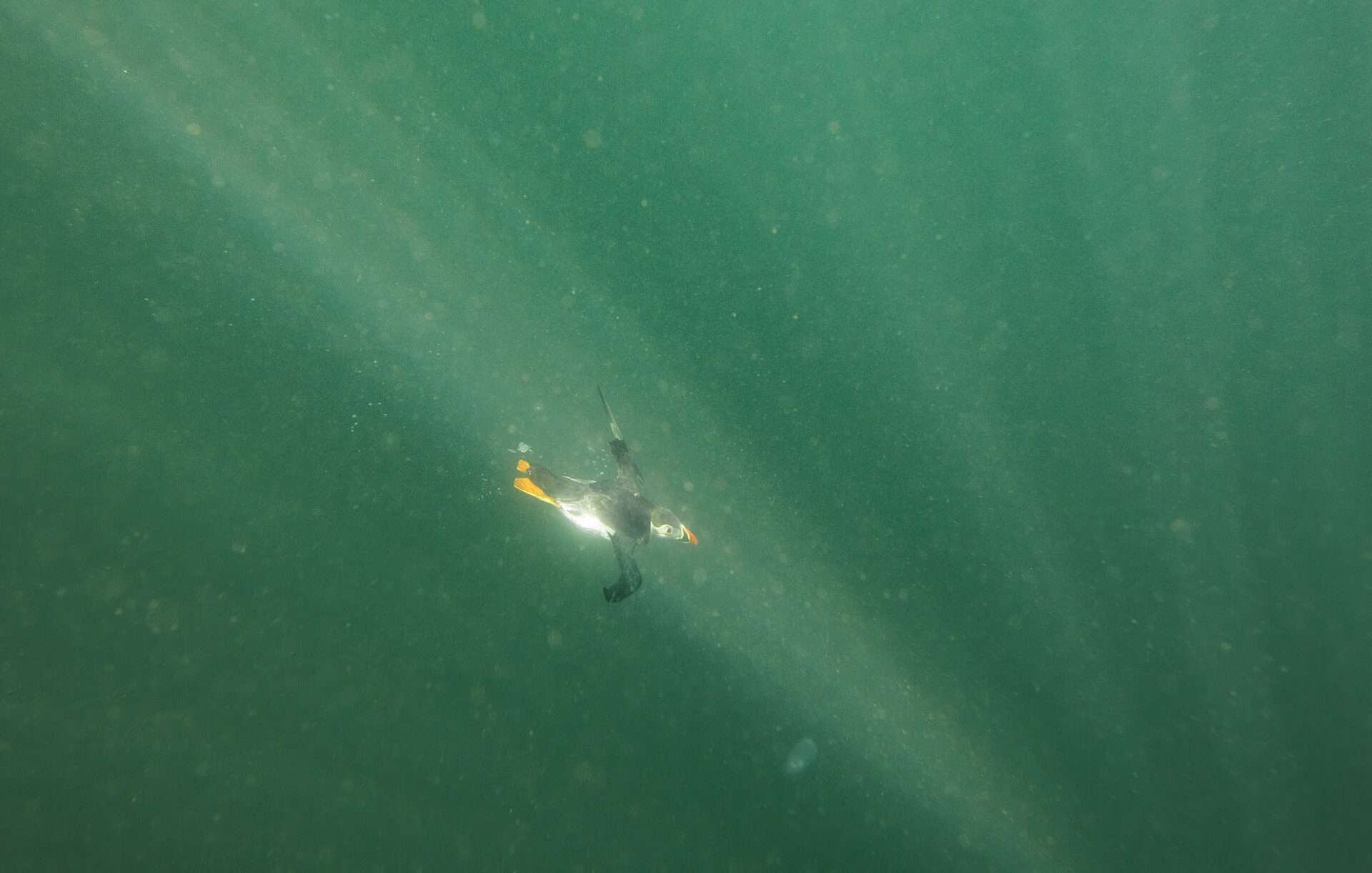
In July 2025 I photographed puffins underwater as they began leaving the islands. They use their wings to fly underwater, with the same beat they use in the air. Many swam right up to me, tilted their heads, looked at me and drifted off. They are so fast they are hard to photograph. The Times ran one of those pictures that July.
2026
In June 2026 I was back in the water with an EOS R5 Mark II and the RF 70-200mm. I was in early in the morning, moving with the current and swell, catching puffins surfing the chop between dives. Early one Sunday morning I was filming guillemots and razorbills under the surface when gulls lifted the birds off the cliff edges. Four of those pictures became the films on my Getting the Shot page.

Some of the birds leave that day and are not back until April. Very little is known about where they go in winter. I go back out in April to check they have come back.